
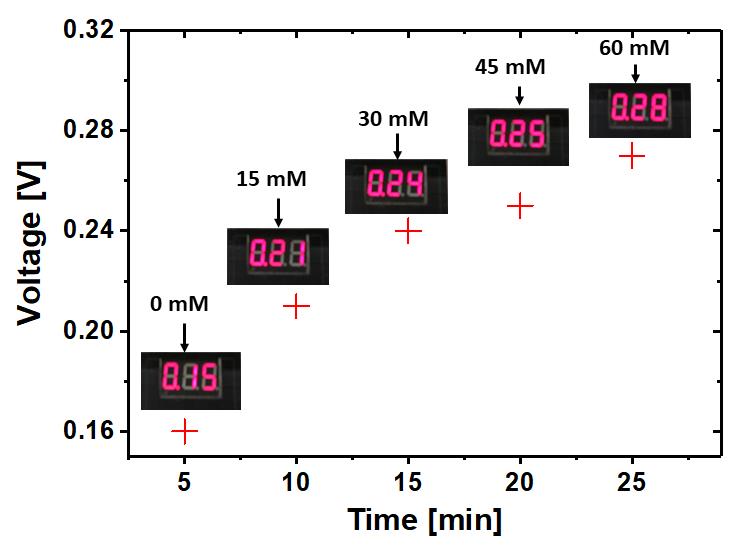
Stand-alone, portable biosensors attract tremendous attention and show remarkable potential for point-of-care diagnostic applications in developing countries.
The use of self-powered sensing strategies can be a realistic and accessible solution because the sensing processes themselves provide power for those applications.
The most conventional self-powered sensing technique uses electrochemical energy conversion, where electrical energy is converted from a sample’s chemical energy and the amount of energy produced can be a function of the sample concentration.
Many studies have demonstrated enzymatic fuel cells as an electrochemical self-powered sensing platform for detecting various analytes including neurochemicals, ascorbic acid, and ethylenediaminetetraacetic acid.
However, enzymatic fuel cells suffer from short lifetime and environmental instability due to the fragile nature of the enzymes and poor immobilization techniques.
Here, we demonstrate another type of biofuel cell, the microbial fuel cell (MFC), as a self-powered sensing strategy. MFCs use whole microorganisms with complete enzymatic pathways and self-assembling, self-repairing living systems.
Furthermore, the readout process requires only a simple, widely available, and inexpensive voltage meter.
← Back to Research